
Embarking on a journey through the intricacies of the SWOT analysis template, this exploration delves into a powerful strategic tool essential for businesses of all sizes. The SWOT framework, encompassing Strengths, Weaknesses, Opportunities, and Threats, offers a comprehensive lens through which to examine both internal and external factors influencing a company’s trajectory. This guide will meticulously dissect each element, providing actionable insights and practical applications to empower strategic decision-making.
From understanding the fundamental components of the SWOT framework to crafting actionable strategies based on its findings, this analysis provides a step-by-step approach. We’ll explore diverse business scenarios, learn how to formulate insightful questions, and build a user-friendly template for streamlined data collection. Ultimately, the goal is to transform raw data into valuable insights, enabling businesses to capitalize on their strengths, mitigate weaknesses, seize opportunities, and navigate potential threats.
Understanding the Fundamental Elements of a SWOT Framework will clarify its core components.
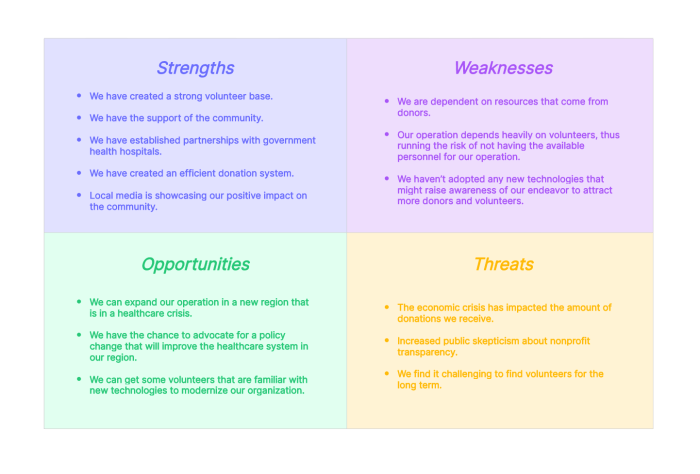
A SWOT analysis is a strategic planning tool used to evaluate the Strengths, Weaknesses, Opportunities, and Threats involved in a project or in a business venture. The framework provides a structured approach for assessing a company’s position relative to its competitors and the external environment. This method facilitates informed decision-making by identifying key internal and external factors that can impact a company’s success. It serves as a foundation for developing strategic plans and adapting to changing market conditions.
Defining the Core Components of SWOT
The SWOT analysis comprises four key elements, each playing a crucial role in understanding a company’s position. Each element offers a distinct perspective on the company’s internal and external environments. Understanding each of these elements is vital for a comprehensive analysis.
- Strengths: These are the internal attributes of the organization that are helpful to achieving the objective. They represent what the company does well and the advantages it possesses. Strengths can be resources, capabilities, or competitive advantages that set the company apart from its rivals. Examples include a strong brand reputation, proprietary technology, a skilled workforce, or a well-established distribution network.
- Weaknesses: These are the internal attributes of the organization that are harmful to achieving the objective. Weaknesses are the areas where the company falls short or has limitations. These can be deficiencies in resources, capabilities, or processes that hinder the company’s performance. Common weaknesses include outdated technology, a lack of financial resources, poor customer service, or inefficient operations.
- Opportunities: These are external factors that are helpful to achieving the objective. Opportunities represent favorable external conditions or trends that the company can leverage to its advantage. These might include emerging markets, technological advancements, changes in government regulations, or shifts in consumer preferences. Identifying opportunities is crucial for strategic growth and expansion.
- Threats: These are external factors that are harmful to achieving the objective. Threats are external factors that could potentially harm the company. These can include increased competition, economic downturns, changes in consumer behavior, or new regulations. Recognizing and mitigating threats is essential for protecting the company’s market position and ensuring its survival.
Comparing Strengths and Weaknesses
Strengths and weaknesses are both internal factors, but they represent opposite sides of the same coin. Strengths are positive attributes, while weaknesses are negative attributes. The following table provides a detailed comparison of the characteristics that distinguish strengths and weaknesses.
| Characteristic | Strengths | Weaknesses | Examples | Examples |
|---|---|---|---|---|
| Nature | Positive internal attributes. | Negative internal attributes. | A loyal customer base. | High employee turnover. |
| Focus | What the company does well. | Areas where the company needs improvement. | Strong brand recognition. | Inefficient supply chain. |
| Impact | Enhance competitive advantage. | Hinder competitive advantage. | Proprietary technology. | Lack of financial resources. |
| Source | Internal resources, capabilities, and advantages. | Internal limitations and deficiencies. | Experienced management team. | Outdated equipment. |
Understanding Internal and External Factors
The SWOT framework categorizes factors into internal and external categories. This distinction is crucial for understanding the forces that shape a company’s performance. Internal factors are within the company’s control, while external factors are generally outside its control.
Internal factors, encompassing strengths and weaknesses, are typically those over which a company has direct influence. These include its resources, capabilities, organizational structure, and culture. A company can leverage its strengths to capitalize on opportunities and mitigate its weaknesses to reduce threats. For instance, a company with a strong research and development (R&D) team (a strength) can develop innovative products to take advantage of emerging market trends (an opportunity). Conversely, a lack of financial resources (a weakness) may limit the company’s ability to invest in new technologies, increasing the risk of being overtaken by competitors (a threat). Internal factors are typically addressed through strategic planning, process improvements, and resource allocation.
External factors, encompassing opportunities and threats, exist outside the company’s direct control. These factors include market trends, competition, economic conditions, technological advancements, and government regulations. Companies must monitor and analyze the external environment to identify opportunities to exploit and threats to avoid. For example, a shift in consumer preferences towards sustainable products (an opportunity) might prompt a company to invest in eco-friendly manufacturing processes. However, increased competition from new entrants (a threat) could necessitate a company to differentiate its products or services to maintain market share. External factors are typically addressed through strategic adaptation, market analysis, and proactive risk management. By understanding both internal and external factors, companies can formulate strategies that align with their capabilities and the dynamics of the marketplace.
Selecting the Right Business Scenarios for Employing a SWOT Tool will demonstrate its versatility.
The SWOT framework is a versatile strategic planning tool, but its effectiveness hinges on its appropriate application. Understanding when and where to deploy a SWOT analysis is crucial for maximizing its benefits. This section explores several business scenarios where a SWOT analysis proves particularly valuable, alongside key indicators signaling its necessity and a visual guide for its application in a new product launch.
Business Scenarios for SWOT Implementation
The SWOT framework’s adaptability makes it ideal for a variety of strategic challenges. Here are three distinct scenarios where a SWOT analysis offers significant advantages:
1. Market Entry Strategy: Entering a new market requires a comprehensive understanding of the competitive landscape, potential opportunities, and inherent risks. A SWOT analysis allows a company to assess its internal strengths and weaknesses relative to external opportunities and threats within the target market. For instance, a technology company considering entering the Latin American market could use SWOT to identify its competitive advantages (e.g., innovative technology) and weaknesses (e.g., limited brand recognition). Simultaneously, it can assess opportunities (e.g., growing internet penetration) and threats (e.g., established local competitors). This analysis can then inform decisions about market entry strategies, including product adaptation, pricing, and distribution channels. The SWOT framework helps companies make informed decisions by systematically evaluating the internal and external factors influencing success.
2. Mergers and Acquisitions (M&A) Evaluation: Before engaging in an M&A transaction, a thorough assessment of the target company is essential. A SWOT analysis facilitates this by providing a structured framework to evaluate the target’s financial health, operational efficiency, and market position. By identifying the target’s strengths (e.g., strong customer base, proprietary technology) and weaknesses (e.g., outdated infrastructure, high debt), the acquiring company can assess potential synergies and integration challenges. Simultaneously, it can evaluate external opportunities (e.g., market expansion, new product lines) and threats (e.g., regulatory changes, economic downturns). This information is crucial for determining the fair valuation of the target company, negotiating favorable terms, and developing a post-merger integration plan. For example, a pharmaceutical company looking to acquire a smaller biotech firm would use SWOT to evaluate the target’s pipeline of drug candidates, intellectual property, and research capabilities, as well as the competitive landscape and regulatory hurdles.
3. Strategic Restructuring and Turnaround: Companies facing declining performance or significant industry shifts often require strategic restructuring. A SWOT analysis provides a clear and concise overview of the company’s current situation, identifying areas for improvement and potential avenues for growth. It allows management to assess internal capabilities, identify core competencies, and evaluate external market dynamics. For example, a retail company experiencing declining sales and increasing competition from online retailers could use SWOT to assess its strengths (e.g., established brand, loyal customer base) and weaknesses (e.g., outdated stores, inefficient supply chain). It can also identify opportunities (e.g., expanding online presence, launching new product lines) and threats (e.g., changing consumer preferences, economic recession). This analysis can then inform decisions about store closures, workforce reductions, investment in e-commerce, and product diversification. This structured approach helps companies make informed decisions, prioritize initiatives, and improve their chances of a successful turnaround.
Key Indicators for SWOT Assessment
Several key indicators suggest that a company should utilize a SWOT assessment to inform its strategic decision-making.
- Declining Market Share: A consistent decrease in market share signals potential weaknesses within the company or external threats from competitors. A SWOT analysis helps identify the root causes of the decline, such as ineffective marketing, outdated products, or aggressive competitor strategies.
- Increased Competition: When new competitors enter the market or existing competitors become more aggressive, a SWOT analysis can help a company understand its competitive advantages and disadvantages. This assessment helps the company develop strategies to differentiate itself and maintain its market position.
- New Product or Service Launch: Introducing a new product or service requires a thorough evaluation of its potential. A SWOT analysis can assess internal capabilities (strengths and weaknesses) and external factors (opportunities and threats) to determine the likelihood of success.
- Significant Industry Changes: Rapid technological advancements, regulatory changes, or shifts in consumer behavior can significantly impact a company’s business model. A SWOT analysis allows companies to adapt to these changes by identifying new opportunities and mitigating potential threats.
- Poor Financial Performance: Persistent losses, declining profitability, or increasing debt levels often indicate underlying problems within the company. A SWOT analysis can help identify the causes of these issues, such as inefficient operations, high costs, or ineffective sales strategies.
Visual Representation: New Product Launch SWOT
The SWOT framework can be visually represented to facilitate understanding and action planning for a new product launch. The following is a descriptive Artikel:
A large square is divided into four quadrants.
* Top Left: Strengths. This quadrant contains bullet points highlighting the company’s internal strengths related to the new product launch.
- Established Brand Reputation
- Strong Distribution Network
- Experienced Development Team
* Top Right: Weaknesses. This quadrant lists the company’s internal weaknesses related to the launch.
- Limited Marketing Budget
- Lack of Experience in New Market
- Potential Manufacturing Constraints
* Bottom Left: Opportunities. This quadrant Artikels external opportunities the company can leverage.
- Growing Market Demand
- Favorable Regulatory Environment
- Partnership Opportunities
* Bottom Right: Threats. This quadrant identifies external threats that could impact the product launch.
- Intense Competition
- Changing Consumer Preferences
- Economic Downturn
Below the SWOT quadrants, a separate section is included for “Action Planning.” This section contains three columns: “Strength,” “Weakness,” “Opportunity,” and “Threat.” Each column has several rows to note specific actions that address each element.
For example:
* Strength: “Leverage existing brand recognition to create marketing campaigns”.
* Weakness: “Secure additional funding for marketing”
* Opportunity: “Develop partnerships with key retailers to increase distribution”
* Threat: “Monitor competitor pricing and adjust pricing strategies accordingly”.
Crafting Effective Questions to Drive a Comprehensive SWOT Evaluation is critical for successful implementation.

Formulating well-defined questions is the cornerstone of a successful SWOT analysis. The quality of the insights gleaned directly correlates with the depth and precision of the questions asked. A comprehensive and insightful SWOT analysis requires probing inquiries that encourage a thorough examination of both internal and external factors influencing a company’s performance and future prospects. This approach facilitates a strategic assessment, enabling informed decision-making and the development of effective strategies.
Identifying Strengths Through Focused Inquiry
To effectively uncover a company’s strengths, the questions must delve into its core competencies, competitive advantages, and internal resources. This process requires a systematic approach, designed to elicit detailed and actionable information. The following examples illustrate how to formulate insightful questions to reveal a company’s strengths.
- Examining Core Competencies: What specific skills or expertise does the company possess that are difficult for competitors to replicate? For instance, a pharmaceutical company might possess a unique expertise in drug discovery and development, a strength that stems from years of research and a team of highly skilled scientists.
- Assessing Competitive Advantages: What aspects of the company’s products or services differentiate it from its rivals, and how do these advantages contribute to its market position? Consider a software company with a user-friendly interface and exceptional customer support, offering a superior customer experience compared to competitors.
- Evaluating Resource Allocation: How effectively does the company utilize its resources, including financial capital, human capital, and intellectual property, to achieve its strategic goals? A technology firm might excel at securing venture capital funding, enabling rapid product development and market expansion.
- Analyzing Brand Reputation: What is the company’s brand perception in the market, and how does this perception influence customer loyalty and trust? A luxury fashion brand might have a strong brand reputation built on heritage, quality, and exclusivity, attracting a loyal customer base.
- Identifying Operational Efficiencies: What internal processes and operational efficiencies contribute to the company’s profitability and cost-effectiveness? A manufacturing company could have a highly efficient supply chain, minimizing production costs and ensuring timely delivery of products.
Building a User-Friendly SWOT Template for Streamlined Data Collection is essential for practical application.
Creating a practical and easily navigable SWOT template is crucial for efficiently gathering and analyzing strategic information. A well-designed template simplifies the process, ensuring consistent data collection and facilitating insightful analysis. This section provides a step-by-step guide to building such a template using a common word processing program, highlighting essential formatting techniques and customization options.
Creating a Basic SWOT Template in a Word Processing Program
The creation of a basic SWOT template in a word processing program like Microsoft Word or Google Docs is straightforward, offering a readily accessible and easily modifiable tool for strategic planning. This process involves setting up the basic structure, incorporating data input fields, and applying formatting to enhance readability and usability.
To design the template, follow these steps:
1. Open a New Document: Start by opening a new, blank document in your chosen word processing program. This provides a clean canvas for your template.
2. Create the SWOT Grid: The core of the template is a 2×2 grid representing the four SWOT quadrants. Use the “Insert Table” function to create a table with two rows and two columns.
3. Label the Quadrants: Label each cell of the table appropriately. In the top-left cell, type “Strengths.” In the top-right cell, type “Weaknesses.” In the bottom-left cell, type “Opportunities,” and in the bottom-right cell, type “Threats.”
4. Format the Headings: To make the headings stand out, apply formatting such as bolding and increasing the font size. This will make it easier to visually identify each quadrant. Consider using a consistent font and color scheme for the headings to improve the template’s overall aesthetic appeal and readability.
5. Add Descriptive Text Below Headings: Under each heading, provide a brief description or a set of guiding questions. This helps users understand what information to include in each section. For example, under “Strengths,” you might write, “List the internal advantages your business possesses, such as skilled employees or strong brand reputation.”
6. Insert Input Fields (Data Collection): This is where you incorporate fields for data input. Consider using bullet points to list the fields needed. For each bullet point, the user will add the relevant information.
- Strengths:
- Core Competencies:
- Competitive Advantages:
- Unique Selling Propositions:
- Resources:
- Financial Stability:
- Weaknesses:
- Areas for Improvement:
- Lack of Resources:
- Negative Aspects of the Business:
- Operational Inefficiencies:
- Financial Constraints:
- Opportunities:
- Market Trends:
- Technological Advancements:
- Untapped Market Segments:
- Changing Regulations:
- Partnership Possibilities:
- Threats:
- Competition:
- Economic Downturns:
- Changing Customer Preferences:
- New Regulations:
- Supply Chain Disruptions:
7. Format the Input Areas: Leave ample space under each heading for users to write their answers. Consider using a different font or style for the input areas to distinguish them from the headings. You can also adjust the row heights to provide more space for longer responses.
8. Save the Template: Save the document as a template file (.dotx in Word or a similar format in other programs) to preserve the formatting and easily reuse it for future SWOT analyses.
Customizing the Template for Different Business Sizes and Sectors
A well-designed SWOT template is adaptable, capable of serving diverse business needs across various sectors. The key to effective customization lies in adjusting the template’s structure and content to reflect the specific context of the business and the goals of the analysis.
Adjustments may include:
* Business Size: For smaller businesses, the template might be more concise, focusing on core aspects. Larger organizations may require a more detailed template with multiple sub-categories within each SWOT quadrant. For instance, a small startup might focus on a few key strengths, while a multinational corporation would analyze several different business units and departments.
* Sector-Specific Considerations: Tailoring the template to specific industries ensures relevance. For example, a technology company’s template might emphasize intellectual property, while a retail business would focus on location, customer service, and supply chain. For a pharmaceutical company, the template might incorporate sections on regulatory approvals and clinical trial data.
* Adding or Removing Sections: You can add or remove sections based on the business’s specific needs. If a business is particularly concerned about environmental sustainability, you could add a section under “Opportunities” to assess green initiatives. Conversely, if a certain aspect is not relevant, it can be omitted to avoid clutter.
* Modifying Questions and Prompts: Adjust the guiding questions under each heading to reflect the unique challenges and opportunities faced by the business. Instead of a general question, you could include prompts such as “What is the business’s current market share?” or “What new technologies are emerging?”
* Using Color-Coding and Visual Aids: Employ color-coding to categorize items within each quadrant or to highlight key findings. Incorporating visual aids, such as charts or diagrams, can enhance the presentation of the SWOT analysis, particularly when sharing it with stakeholders.
By adapting the template to these factors, businesses can ensure that the SWOT analysis is a targeted, relevant, and effective tool for strategic planning.
Analyzing the Collected Data within the SWOT Template to Gain Valuable Insights is the ultimate goal of this exercise.
The culmination of the SWOT analysis lies in the ability to extract actionable intelligence from the collected data. This process transforms raw information into strategic recommendations, guiding decision-making and fostering a proactive approach to business challenges and opportunities. Careful analysis is critical to avoid superficial conclusions and instead, delve into the nuances of each SWOT quadrant, uncovering interconnected relationships that drive effective strategic planning.
This section Artikels the steps necessary to translate raw data into valuable insights, enabling informed decision-making and strategic planning. The focus is on practical application, demonstrating how to categorize, organize, and interpret data within the SWOT framework to achieve meaningful outcomes.
Categorizing Data into SWOT Quadrants
The first step involves meticulously sorting the collected data into the four quadrants of the SWOT framework: Strengths, Weaknesses, Opportunities, and Threats. This categorization requires careful consideration of each data point, ensuring accurate placement based on its inherent characteristics. The goal is to create a clear and organized foundation for subsequent analysis. Each point should be categorized based on its impact on the organization’s ability to achieve its objectives. For example, a new, patented technology would be classified as a Strength, while an aging infrastructure would be a Weakness. A change in consumer preferences represents an Opportunity, and increasing competition is a Threat.
- Strengths: Internal attributes that give the organization an advantage. These are the positive internal factors that contribute to the organization’s success. Examples include strong brand reputation, efficient processes, and skilled employees.
- Weaknesses: Internal attributes that put the organization at a disadvantage. These are the negative internal factors that hinder the organization’s performance. Examples include outdated technology, high employee turnover, and lack of financial resources.
- Opportunities: External factors that the organization can leverage to its advantage. These are the positive external factors that the organization can capitalize on. Examples include emerging markets, technological advancements, and favorable government regulations.
- Threats: External factors that can negatively impact the organization. These are the negative external factors that the organization must mitigate. Examples include increasing competition, economic downturns, and changing consumer preferences.
Organizing Data in a SWOT Matrix
Once the data is categorized, it’s essential to organize it into a matrix to facilitate cross-referencing and identify relationships between the different SWOT elements. This visual representation allows for a comprehensive understanding of the strategic landscape. The matrix format helps reveal how strengths can be used to capitalize on opportunities, how weaknesses can be addressed to avoid threats, and how strengths can be leveraged to mitigate threats. This visual approach streamlines the analysis process and helps identify potential strategic actions.
The SWOT matrix is structured as a table with four columns, representing each SWOT quadrant. The rows typically contain the specific items identified in each quadrant, facilitating a comparative analysis. This structure allows for a clear visualization of the interplay between internal and external factors. The cross-referencing of elements within the matrix is crucial for formulating effective strategies. This approach ensures that all elements are considered in a systematic and organized manner, leading to more informed decision-making.
| Strengths (Internal, Positive) | Weaknesses (Internal, Negative) | Opportunities (External, Positive) | Threats (External, Negative) |
|---|---|---|---|
| Brand Recognition | High Production Costs | Expanding Market Demand | Increased Competition |
| Efficient Distribution Network | Outdated Technology | Technological Advancements | Economic Recession |
| Skilled Workforce | Limited Financial Resources | Favorable Government Regulations | Changing Consumer Preferences |
Deriving Strategic Actions from SWOT Analysis
The ultimate goal of a SWOT analysis is to translate the findings into actionable strategies. The analysis of the SWOT matrix should guide the development of specific initiatives aimed at leveraging strengths, mitigating weaknesses, capitalizing on opportunities, and avoiding threats. These strategic actions should be measurable, achievable, relevant, and time-bound (SMART). The strategic actions derived from the SWOT analysis should directly address the key findings identified in the matrix. Each action should have a clear objective and a defined plan for implementation. The following are examples of potential strategic actions derived from the SWOT analysis framework.
- Strength-Opportunity (SO) Strategies: These strategies focus on using the organization’s strengths to take advantage of opportunities. For example, if a company has a strong brand reputation (Strength) and there’s growing market demand (Opportunity), a strategic action could be to launch a new product line leveraging the brand’s established credibility.
- Strength-Threat (ST) Strategies: These strategies aim to use the organization’s strengths to minimize or avoid threats. For instance, if a company has a highly skilled workforce (Strength) and faces increasing competition (Threat), a strategic action could be to invest in advanced training programs to maintain a competitive edge.
- Weakness-Opportunity (WO) Strategies: These strategies focus on improving weaknesses by taking advantage of opportunities. For example, if a company has outdated technology (Weakness) and there are technological advancements (Opportunity), a strategic action could be to invest in upgrading its technology to improve efficiency.
- Weakness-Threat (WT) Strategies: These strategies are defensive, aiming to minimize weaknesses and avoid threats. For example, if a company has limited financial resources (Weakness) and faces an economic recession (Threat), a strategic action could be to implement cost-cutting measures and seek alternative funding sources.
- Focus on core competencies: By identifying and concentrating on core competencies (Strengths), a company can build a sustainable competitive advantage. For example, a company with expertise in customer service should prioritize investments in customer relationship management (CRM) systems and training programs.
- Diversification: If a company faces a threat like changing consumer preferences, diversification into new product lines or markets (leveraging existing strengths) can mitigate risk. For example, a company that sells physical books could diversify into e-books and audiobooks.
Developing Actionable Strategies Based on the SWOT Template Findings ensures a productive outcome.
Translating the insights gleaned from a SWOT analysis into concrete strategies is crucial for driving organizational progress. This step moves beyond mere observation, transforming identified strengths, weaknesses, opportunities, and threats into a roadmap for strategic action. The following sections detail how to bridge this gap, providing examples and a framework for prioritization and monitoring.
Creating Actionable Strategies Based on SWOT Elements
The SWOT analysis provides a framework for strategic decision-making. Each element—Strengths, Weaknesses, Opportunities, and Threats—should be addressed with specific, actionable strategies.
* Leveraging Strengths (SO Strategies): These strategies aim to utilize internal strengths to capitalize on external opportunities. For example, a company with a strong brand reputation (strength) might launch a new product line in a growing market (opportunity). The strategy would involve leveraging the brand’s positive image to facilitate product acceptance and market penetration.
* Addressing Weaknesses (WO Strategies): These strategies focus on overcoming internal weaknesses by taking advantage of external opportunities. If a company lacks a robust online presence (weakness) but the market is shifting towards e-commerce (opportunity), the strategy would be to invest in website development, digital marketing, and online sales channels.
* Utilizing Strengths to Mitigate Threats (ST Strategies): This involves using internal strengths to minimize the impact of external threats. For example, a company with a strong research and development team (strength) might counter the threat of a competitor’s new product (threat) by accelerating its own product innovation cycle.
* Minimizing Weaknesses and Avoiding Threats (WT Strategies): These are defensive strategies designed to protect the organization. If a company has high production costs (weakness) and faces economic recession (threat), the strategy might involve streamlining operations, reducing overhead, and exploring cost-effective sourcing options to survive the downturn.
Prioritizing Strategies for Maximum Impact
Not all strategies will be equally impactful or feasible. Prioritization ensures resources are allocated effectively.
- Assess Potential Impact: Evaluate each strategy’s potential to improve performance, increase revenue, or mitigate risk. Consider the scale of the expected effect.
- Determine Feasibility: Assess the resources required (financial, human, technological) and the likelihood of successful implementation.
- Estimate Urgency: Prioritize strategies based on the immediacy of the threat or the time-sensitive nature of the opportunity.
- Calculate Strategic Alignment: Ensure strategies align with the overall business goals and mission. Strategies that support key objectives should be prioritized.
A matrix, with impact and feasibility as axes, can visually represent the prioritization process. High-impact, high-feasibility strategies should be implemented first.
Monitoring Progress Through Key Performance Indicators
Tracking the progress of implemented strategies is essential to ensure they are achieving the desired outcomes. This requires establishing Key Performance Indicators (KPIs) and regularly monitoring performance against these metrics.
KPIs should be specific, measurable, achievable, relevant, and time-bound (SMART). The selection of KPIs depends on the specific strategies being implemented. For example:
* For a strategy focused on launching a new product line (leveraging a strength), relevant KPIs might include:
- Sales volume of the new product (units sold or revenue generated).
- Market share achieved by the new product.
- Customer acquisition cost for the new product.
* For a strategy addressing a weakness, such as improving online presence, KPIs could include:
- Website traffic (unique visitors, page views).
- Conversion rates (e.g., website visitors to leads or customers).
- Social media engagement (likes, shares, comments).
* For a strategy mitigating a threat, such as responding to a competitor’s new product, KPIs might involve:
- Customer retention rate.
- Market share relative to the competitor.
- Customer satisfaction scores.
* Regularly review KPIs against established targets, ideally on a monthly or quarterly basis. This data-driven approach allows for adjustments to the strategy if performance falls short of expectations. The monitoring process provides insights that enable informed decision-making and continuous improvement. Consider a scenario where a company, facing increasing competition (threat), implements a customer loyalty program (strategy). The KPIs could include the percentage of customers enrolled in the program, the average spending of enrolled customers compared to non-enrolled customers, and customer satisfaction scores. Tracking these metrics would reveal the program’s effectiveness and guide any necessary adjustments.
Conclusive Thoughts
In conclusion, the SWOT analysis template serves as a vital compass for navigating the complex landscape of business strategy. By understanding its core elements, selecting appropriate scenarios, and crafting effective questions, businesses can unlock invaluable insights. From designing user-friendly templates to analyzing collected data and developing actionable strategies, this framework empowers informed decision-making. Embracing the SWOT analysis is not merely a task; it’s a commitment to strategic foresight, ensuring sustainable growth and competitive advantage in an ever-evolving market.
